
 Español
 Pусский
 Français
 العربية
wheeled quadruped mobile robot
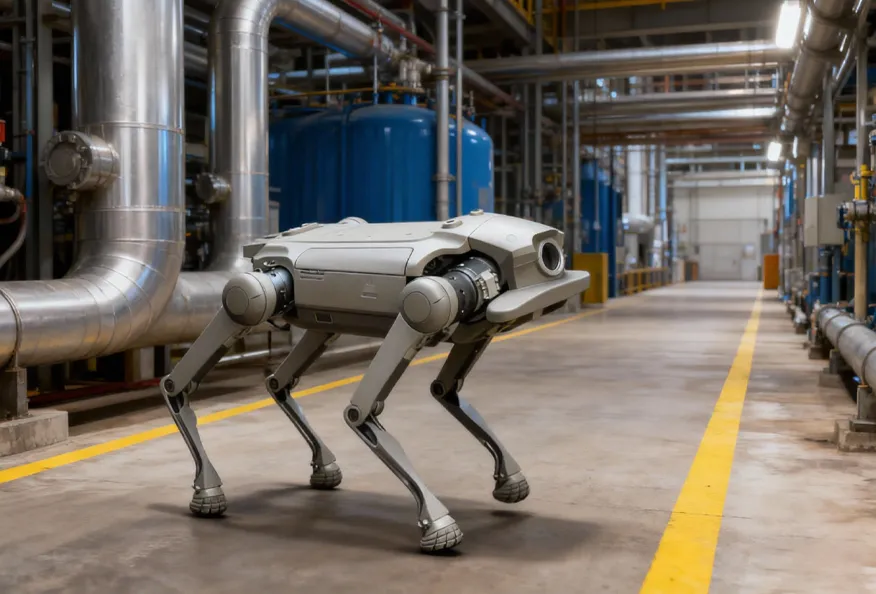
Wheeled Quadruped Mobile Robot: Design and Applications A wheeled quadruped mobile robot is a hybrid robotic platform that combines the stability and mobility of quadruped legs with the efficiency and speed of wheels. This innovative design enables the robot to navigate diverse terrains, from flat surfaces to rough or uneven landscapes, making it highly versatile for various applications. Mechanical Design The robot typically features four articulated legs, each equipped with a wheel at the end. The legs provide dynamic balance and adaptability, allowing the robot to step over obstacles, climb stairs, or adjust its posture for stability. The wheels enhance speed and energy efficiency when moving on smooth surfaces, reducing friction and power consumption compared to pure legged locomotion. The joints of the legs are usually powered by high-torque actuators, such as servo motors or hydraulic systems, enabling precise control over movement. Some designs incorporate passive or active suspension mechanisms to absorb shocks and maintain stability. The wheels can be either fixed or actively driven, depending on the required maneuverability. Locomotion Modes 1. Wheeled Mode: On flat or structured surfaces, the robot lowers its legs to allow the wheels to make contact with the ground, enabling fast and efficient rolling motion. This mode is ideal for long-distance travel with minimal energy expenditure. 2. Legged Mode: In challenging terrain, the robot lifts its wheels and transitions to walking or crawling. The legs provide adaptability, allowing the robot to traverse gaps, stairs, or debris. 3. Hybrid Mode: Some advanced models can combine both modes, using wheels for speed while adjusting leg positions to maintain balance or overcome obstacles. Sensing and Control To navigate autonomously, the robot integrates multiple sensors, including LiDAR, cameras, IMUs (Inertial Measurement Units), and force/torque sensors. These sensors enable environment perception, obstacle avoidance, and gait adaptation. Control algorithms, often based on reinforcement learning or model predictive control, optimize locomotion efficiency and stability. Applications 1. Search and Rescue: The robot can maneuver through disaster zones, delivering supplies or inspecting unstable structures. 2. Industrial Inspection: It can navigate factories, warehouses, or construction sites, performing maintenance checks in hard-to-reach areas. 3. Military & Defense: Its hybrid mobility makes it suitable for reconnaissance missions in varied terrains. 4. Logistics & Delivery: In urban environments, it can efficiently transport goods while handling curbs or stairs. Advantages and Challenges Advantages: - Combines the speed of wheels with the adaptability of legs. - Suitable for both structured and unstructured environments. - Energy-efficient compared to pure legged robots on flat terrain. Challenges: - Complex mechanical design increases manufacturing costs. - Control algorithms must seamlessly transition between locomotion modes. - Battery life and actuator durability remain critical concerns. In summary, the wheeled quadruped mobile robot represents a significant advancement in robotics, offering a balanced solution for diverse real-world applications where flexibility and efficiency are essential. Future improvements in AI, materials, and energy systems will further enhance its capabilities.
Products
Category:
-

Wheeled Medium-Sized Quadruped Robot – Industrial Automation and AI Robotics Platform
Category: Robot DogBrowse number: 30Number:Release time: 2025-12-26 16:33:00Wheeled Medium-Sized Quadruped Robot – Industrial Automation and AI Robotics Platform -

Wheeled Medium-Sized Quadruped Robot – Ruggedized for Construction Site Monitoring & Safety Patrol
Category: Robot DogBrowse number: 24Number:Release time: 2025-12-26 16:40:24Wheeled Medium-Sized Quadruped Robot – Ruggedized for Construction Site Monitoring & Safety Patrol -
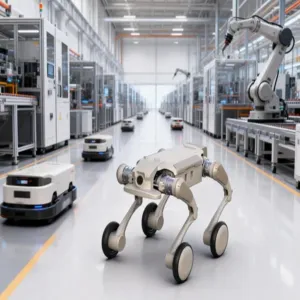
Wheeled Medium-Sized Quadruped Robot – Multifunctional Platform with Interchangeable Payload Modules
Category: Robot DogBrowse number: 20Number:Release time: 2025-12-26 16:45:22Wheeled Medium-Sized Quadruped Robot – Multifunctional Platform with Interchangeable Payload Modules -
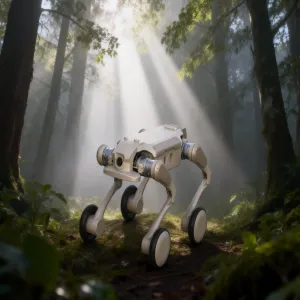
Wheeled Medium-Sized Quadruped Robot – Real-Time Data Collection and 3D Mapping Specialist
Category: Robot DogBrowse number: 22Number:Release time: 2025-12-26 16:47:10Wheeled Medium-Sized Quadruped Robot – Real-Time Data Collection and 3D Mapping Specialist -

Wheeled Medium-Sized Quadruped Robot – Rapid Deployment Solution for Emergency Response Scenarios
Category: Robot DogBrowse number: 19Number:Release time: 2025-12-26 17:05:11Wheeled Medium-Sized Quadruped Robot – Rapid Deployment Solution for Emergency Response Scenarios -

Wheeled Medium-Sized Quadruped Robot – Cloud-Connected Fleet Management and Analytics Dashboard
Category: Robot DogBrowse number: 15Number:Release time: 2025-12-26 17:08:48Wheeled Medium-Sized Quadruped Robot – Cloud-Connected Fleet Management and Analytics Dashboard
News
Category:
-
[Company News]Small Quadruped Robot for Research and Education: China-Buil...
2026-01-06 17:57:00
Case
Category:

Video
Category:
No search results found!
Download
Category:
No search results found!
Job
Category:
No search results found!
Featured Products
No search results found!



 Phone
Phone