I. Project Background
A petrochemical enterprise located within a provincial-level chemical industrial park operates 8 chemical production lines, 32 large-scale raw material storage tanks, and over a hundred key reaction vessels. The facility presents significant operational hazards, including high temperatures (surface temperatures of some equipment reaching 120°C), high pressure (pipeline pressure up to 10 MPa), and risks of toxic/ hazardous gas leaks such as methane and hydrogen sulfide. Previously, the plant relied on a manual "three-shift" inspection model, with 6 inspectors per shift. A single inspection round took 2.5 hours and was plagued by three core pain points:
Safety Risks in Hazardous Zones: Inspections in tank farms and near reactors required personnel to wear heavy protective gear, leading to low efficiency and exposure to risks of poisoning and burns. In 2023, one burn accident occurred when an inspector accidentally contacted a high-temperature pipeline.
High Missed Detection Rate: Manual inspections depended on visual checks of gauge readings and auditory detection of abnormal sounds, resulting in a missed detection rate of 8%. In 2022, a failure to promptly identify an instrument abnormality caused a 4-hour production line shutdown, incurring a direct economic loss of 1.2 million RMB.
Data Lag and Delayed Warning: Inspection data was first recorded on paper and then manually entered into the system, causing a synchronization delay of over 2 hours. This made timely warnings for abnormal situations impossible.
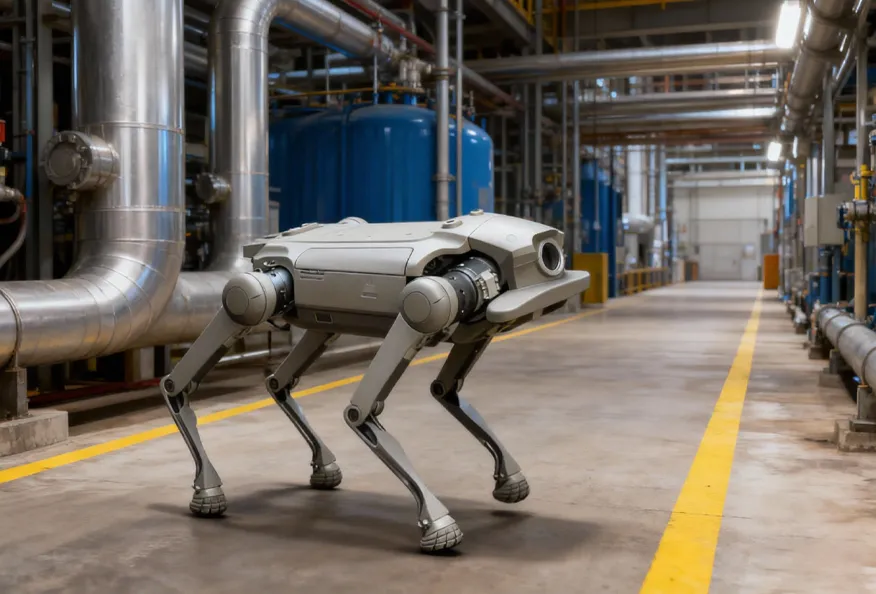
To address these issues, the enterprise introduced 3 industrial inspection robotic dogs in January 2024, establishing an "Unmanned Inspection + Intelligent Early Warning" system.
II. Implementation Process
1. Initial Deployment (January 5 - January 15)
The technical team utilized LiDAR mounted on the robotic dogs to conduct three rounds of comprehensive scanning across the entire plant. Over 12,000 environmental feature points were collected to construct a centimeter-level (0.1m precision) 3D digital twin map. Integrating the enterprise's existing inspection protocols, 8 fixed inspection routes were pre-configured on a cloud platform, marking 168 key detection points. These included:
52 points for gauge readings
38 points for valve status checks
45 points for equipment temperature monitoring
33 points for gas detection
Standard parameter thresholds were set for each point (e.g., methane concentration normal range ≤ 0.5% VOL, normal equipment temperature ≤ 60°C). Data connectivity between the robotic dogs and the enterprise's existing SCADA system was also established, enabling integrated analysis of inspection data and equipment operational data.
2. Trial Operation and Optimization (January 16 - January 31)
A parallel inspection model was adopted, with "robotic dogs as the primary method, supplemented by manual checks." The three robotic dogs were assigned to the eastern, western, and southern zones respectively. Each unit performed 4 inspection rounds daily (at 8:00 AM, 2:00 PM, 8:00 PM, and 2:00 AM), reducing the duration of a single round to 45 minutes.
Two issues were identified during the trial:
Navigation deviations occurred in some pipe-dense areas due to LiDAR signal occlusion. The technical team supplemented the system with visual camera image recognition for auxiliary positioning, improving navigation precision to 0.05 meters.
Gauge reading recognition accuracy under strong nighttime light conditions was initially below 90%. After optimizing the algorithm model and adding an infrared fill-light module, accuracy increased to 99.2%.
3. Formal Operation (February 1 - Present)
The robotic dogs now perform fully autonomous inspections without human intervention. The system generates 3 zonal inspection reports and 1 comprehensive analysis report daily. Abnormal data is pushed in real-time to maintenance personnel's mobile apps and the central control room's large screen.
III. Application Results
1. Significant Reduction in Safety Risks: Inspections in hazardous areas are now entirely conducted by robotic dogs. Personnel are only responsible for backend monitoring and equipment maintenance. Since 2024, no inspection-related safety incidents have occurred. Costs for protective equipment procurement and personnel accident insurance have decreased by 40%.
2. Substantial Improvement in Inspection Efficiency:
A single robotic dog covers a daily inspection distance of 12 km, three times greater than manual inspections.
The missed detection rate dropped to 0.3%, with a false detection rate of 0%.
In 2024, the system successfully provided early warnings for 12 equipment abnormalities (including 5 minor gas leaks, 4 instances of excessive equipment temperature, and 3 valve anomalies). All were addressed before the faults escalated, preventing an estimated 3.6 million RMB in potential downtime losses.
3. Effective Reduction in Operational Costs:
12 inspection positions were eliminated, saving approximately 960,000 RMB annually in labor costs.
Automated data entry and analysis improved the maintenance team's work efficiency by 50%.
Equipment preventive maintenance costs decreased by 25%.
IV. Typical Case Scenario
At 3:12 AM on May 18, 2024, a robotic dog inspecting the western tank farm detected a methane concentration of 0.8% VOL near Tank No. 3 (a propane storage tank), exceeding the standard threshold of 0.5% VOL. It immediately executed a "Three-Level Alert" protocol:
Activated red strobe lights and an audible alarm on-site.
Simultaneously captured close-up images of the tank valve and uploaded them to the cloud.
Sent alert SMS messages with location information to three maintenance supervisors.
Maintenance personnel arrived on-site within 12 minutes. Using the real-time data transmitted by the robotic dog, they pinpointed the source as a leak from an aging valve seal. The seal was replaced, resolving the issue. This early warning prevented a potential explosion risk from further increasing gas concentration, estimated to have averted losses exceeding 2 million RMB.

 RELATED
 RELATED
 RELATED
 RELATED

 Español
 Pусский
 Français
 العربية





 Phone
Phone
Comment
(0)