I. Rescue Background
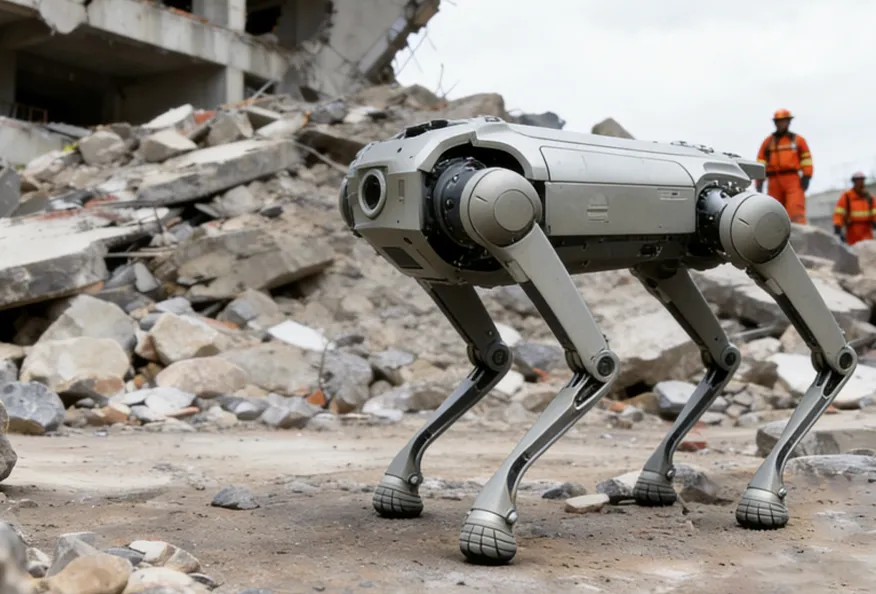
On July 2, 2024, a magnitude 4.8 earthquake struck a county-level city, causing the collapse of a 3-story brick-and-concrete residential building in the old urban area. The site presented multiple hazards, including risk of secondary collapse (ongoing aftershocks), high dust concentration, and a local gas leak. Upon arrival, the local fire and rescue brigade used drone aerial photography and identified a narrow void space formed by the collapse in the central section of the building, suggesting possible trapped individuals. However, direct entry by rescue personnel risked triggering the collapse of the remaining structure. The rescue command center immediately deployed one emergency rescue and detection robotic dog to assist firefighters with on-site reconnaissance.
II. Rescue Implementation Process
1. On-site Deployment (10:05 - 10:10, same day)
Rescue personnel established a temporary command post in a safe zone 50 meters from the collapsed structure and connected it to the robotic dog's backend control system. Based on topographic data provided by the drone, the detection area was set to the central collapsed section (approximately 80 m²), focusing on three zones suspected of containing life signs. The robotic dog activated "Rescue Mode," automatically switching to Beidou short message communication (due to disrupted mobile signals on-site) and adjusting its limb shock absorption mode to adapt to the rubble-strewn terrain.
2. Deep Reconnaissance (10:10 - 10:35)
The robotic dog entered the collapse site at a speed of 0.3 m/s. Its 360-degree panoramic camera transmitted real-time footage, while its thermal imaging life detector continuously scanned for human heat signatures. A toxic gas detector simultaneously monitored concentrations of carbon monoxide and methane. During its advance, the robotic dog autonomously avoided three large concrete blocks (the largest measuring 1.2m × 0.8m × 0.5m) and climbed a 25-degree rubble slope, ultimately reaching the entrance to the narrow void in the central area.
3. Life Sign Confirmation and Rescue Assistance (10:35 - 11:20)
At 10:38, the robotic dog's thermal imager detected two human heat signatures within the void (temperatures 36.2°C and 35.8°C). Simultaneously, its audio recognition module captured faint cries for help. The device immediately marked the location coordinates (36°52'18" N, 118°35'42" E) and sent an alert to the command post stating, "Two trapped individuals located, vital signs stable." The panoramic camera confirmed two victims (an elderly couple) huddled in a corner, with no heavy debris directly压迫 them.
Based on the real-time data transmitted by the robotic dog, the command center formulated a "Unilateral Breaching + Support Reinforcement" rescue plan. The robotic dog continued to monitor the environment (providing real-time feedback on dust concentration and wall stability) while rescue personnel used hydraulic breaching tools to create a 1.2m × 0.8m access通道 on one side of the wall. Jacks were simultaneously deployed to support the surrounding structure and prevent secondary collapse. By 11:15, both trapped individuals were successfully rescued, having sustained only minor abrasions.
4. Secondary Sweep (11:20 - 11:40)
Following the rescue, the robotic dog conducted a secondary sweep of the remaining collapsed areas to confirm no other trapped individuals were present. It also detected a minor gas leak in the eastern section (concentration 0.3% VOL), immediately marking the location and alerting rescue personnel to shut off the main valve, thereby preventing a potential secondary disaster.
III. Demonstrated Rescue Value
1. Ensured Safety of Rescue Personnel: The robotic dog's initial entry into the high-risk zone for reconnaissance eliminated direct exposure of rescue personnel to life-threatening dangers such as secondary collapse or gas inhalation. This operation resulted in zero casualties among the rescue team.
2. Significantly Enhanced Rescue Efficiency: The process from deployment to locating the trapped individuals took only 25 minutes, saving approximately 40 minutes compared to traditional "manual probing + life detector" methods. This crucial time saving provided a vital window for the victims' survival.
3. Enabled Precise, Data-Driven Rescue Strategy: The real-time transmission of topographic data, victim vital signs, and visual imagery allowed for a highly targeted rescue plan. This prevented the risks associated with盲目 (indiscriminate) breaching and ensured the entire operation was conducted both safely and efficiently.

 RELATED
 RELATED
 RELATED
 RELATED

 Español
 Pусский
 Français
 العربية





 Phone
Phone
Comment
(0)