
 Español
 Pусский
 Français
 العربية
research quadruped robot system
Research on Quadruped Robot Systems Quadruped robots, inspired by the locomotion of four-legged animals, represent a rapidly advancing field in robotics. These systems offer superior stability, adaptability, and mobility compared to wheeled or bipedal robots, making them suitable for diverse applications such as search and rescue, exploration in unstructured environments, logistics, and surveillance. Key Components of Quadruped Robot Systems 1. Mechanical Design The mechanical structure of quadruped robots typically includes lightweight yet durable materials like carbon fiber or aluminum alloys to ensure agility and load capacity. Each leg is equipped with multiple degrees of freedom (DoF), often three or four per limb, enabling dynamic movements such as trotting, galloping, and climbing. Advanced designs incorporate compliant mechanisms or passive elastic elements to improve energy efficiency and shock absorption. 2. Actuation and Power Systems High-torque electric motors, hydraulic actuators, or hybrid systems are commonly used for actuation. Electric motors with harmonic drives provide precise control, while hydraulic systems offer higher force output for heavy-duty applications. Power efficiency remains a challenge, with most quadruped robots relying on high-capacity lithium batteries, limiting operational time. Research is ongoing to integrate energy recovery mechanisms and alternative power sources. 3. Perception and Sensing Quadruped robots integrate a suite of sensors, including LiDAR, depth cameras, IMUs, and force/torque sensors, to perceive their surroundings and maintain balance. Real-time terrain mapping and obstacle avoidance are enabled through simultaneous localization and mapping (SLAM) algorithms. Tactile sensors on the feet enhance interaction with uneven surfaces. 4. Control and Locomotion Control strategies for quadruped robots range from model-based approaches to machine learning techniques. Traditional methods rely on inverse kinematics and dynamics to generate stable gaits, while reinforcement learning (RL) enables adaptive locomotion in complex environments. Hybrid control frameworks combine classical controllers with neural networks for robustness. Challenges and Future Directions Key challenges include improving energy autonomy, enhancing robustness in extreme conditions, and reducing manufacturing costs. Future research may focus on bio-inspired designs, swarm coordination, and advanced AI-driven autonomy. As quadruped robots become more capable, their integration into real-world applications will expand, revolutionizing industries from disaster response to agriculture. In summary, quadruped robot systems represent a cutting-edge intersection of mechanics, control theory, and AI, with immense potential to transform robotics. Continued innovation in hardware and software will drive their adoption across diverse domains.
Products
Category:
-
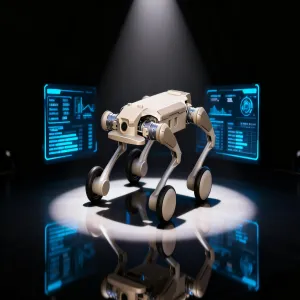
Wheeled Medium-Sized Quadruped Robot – All-Terrain Hybrid Mobility for Warehouse & Yard Logistics
Category: Robot DogBrowse number: 25Number:Release time: 2025-12-26 16:37:26Wheeled Medium-Sized Quadruped Robot – All-Terrain Hybrid Mobility for Warehouse & Yard Logistics -
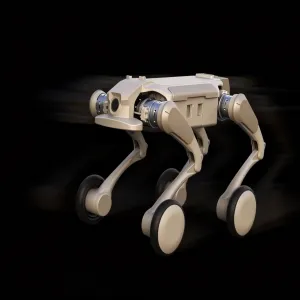
Wheeled Medium-Sized Quadruped Robot – Seamless Integration with Existing Factory Automation Systems
Category: Robot DogBrowse number: 24Number:Release time: 2025-12-26 16:48:50Wheeled Medium-Sized Quadruped Robot – Seamless Integration with Existing Factory Automation Systems -
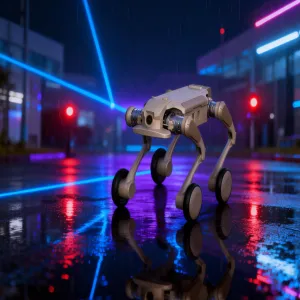
Wheeled Medium-Sized Quadruped Robot – Cost-Effective Automation for SMEs and Research Labs
Category: Robot DogBrowse number: 26Number:Release time: 2025-12-26 16:52:05Wheeled Medium-Sized Quadruped Robot – Cost-Effective Automation for SMEs and Research Labs -
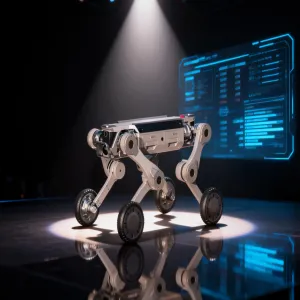
Wheeled Medium-Sized Quadruped Robot – Precision Mobile Platform for Testing & Quality Control
Category: Robot DogBrowse number: 23Number:Release time: 2025-12-26 17:07:26Wheeled Medium-Sized Quadruped Robot – Precision Mobile Platform for Testing & Quality Control -
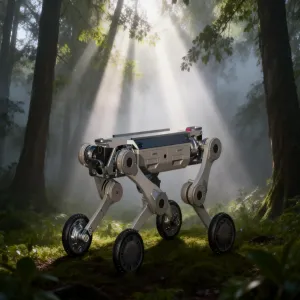
Wheeled Medium-Sized Quadruped Robot – Flexible Leasing and RaaS (Robot-as-a-Service) Plans
Category: Robot DogBrowse number: 37Number:Release time: 2025-12-26 17:15:53Wheeled Medium-Sized Quadruped Robot – Flexible Leasing and RaaS (Robot-as-a-Service) Plans -
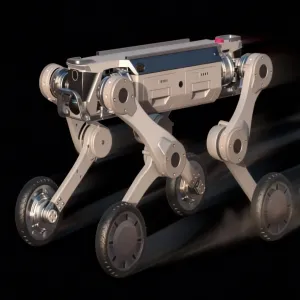
Wheeled Medium-Sized Quadruped Robot – Intuitive Teleoperation and Waypoint Planning Interface
Category: Robot DogBrowse number: 48Number:Release time: 2025-12-26 17:18:42Wheeled Medium-Sized Quadruped Robot – Intuitive Teleoperation and Waypoint Planning Interface
News
Category:
-
[Company News]Wheeled Medium-Sized Quadruped Robot – Intelligent Mobility...
2025-12-26 11:40:35 -
[Company News]Wheeled Medium-Sized Quadruped Robot
2025-12-26 11:42:47 -
[industry news]Xinmite Exports Wheeled Medium-Sized Quadruped Robots to the...
2025-12-26 11:52:07
Case
Category:
No search results found!
Video
Category:
No search results found!
Download
Category:
No search results found!
Job
Category:
No search results found!
Featured Products
No search results found!



 Phone
Phone